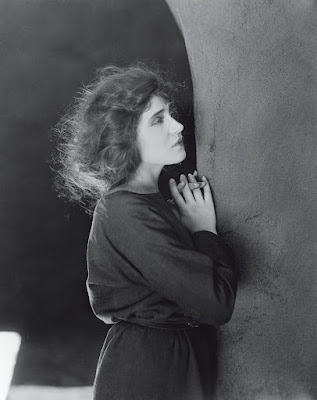
The Life and Times of Actress-turned-Activist Tina Modotti

An advocate for women’s freedoms in the early 20th century, her creative achievements are still celebrated today.

Tina Modotti was an artistic and literal revolutionary. Born Assunta Adelaide Luigia Modotti Mondini on Aug. 16, 1896, in Udine, Italy, Modotti quit elementary school at the age of 12 to earn money to help her family make ends meet. Her father immigrated to the United States, and in 1913, she joined him in San Francisco. There, she became involved in the performing arts and landed parts in plays, operas and films.

Modotti starred in three silent films during the early 1920s. Only one is still in circulation. Adapted from Elizabeth Dejeans’s 1917 novel “The Tiger’s Coat,” Roy Clements’ 1920 drama has stood the test of time due to its forward-thinking takes on racism and society’s views on interracial relationships. A feast for the eyes with elaborate sets and costumes, the film follows Maria de la Guarda, aka Jean Ogilvie (Modotti), as she assumes the identity of a dead woman to hide her ethnicity and marry the man of her dreams. With her simple yet stunning good looks, Modotti radiates the mystique she was known for her entire life from the moment she steps in front of the camera.


Watch “The Tiger’s Coat” on YouTube, with a special intro... 


Modotti could have cashed in on her exquisite beauty but was frustrated with the stereotypical roles being offered to her because of her Mediterranean look, so she left the movie industry. She became interested in photography and studied with legendary lensman Edward Weston. Their rapport turned into love, and the two moved to Mexico together in 1923. The change in scenery profoundly altered the course of Modotti’s life.


The couple became friends with the artists of the Mexican Renaissance, including iconic painter Frida Kahlo and her partner Diego Rivera. For the next several years, Modotti immersed herself in her craft, finding her own voice and style as a photographer. Meanwhile, the political influence of her friends was shaping her societal values, so much so that she joined the Mexican Communist Party in 1927. The line between art and politics blurred as she adapted to her new life in Mexico. She photographed people of all social classes, highlighting the plight of the poor amid the political unrest of the time.

Expelled from Mexico because of her activism, Modotti spent time in various countries throughout Europe during the mid-’30s, including Spain, where she aided orphaned children during the Spanish Civil War. During those years, she connected with prominent artists and intellectuals like Chilean poet Pablo Neruda and Hungarian-American war photographer Robert Capa, both of whom had also journeyed to Spain to offer their support.


Modotti returned to Mexico in 1939 but passed away on Jan. 5, 1942, under suspicious circumstances. The cause of death was listed as heart failure. She was only 45 years old. 


Today, Modotti is highly regarded as a photographer and is frequently the subject of exhibitions around the world. Last year, the Museo delle Culture in Milan played host to the exhibit “Tina Modotti: Women, Mexico, and Freedom.” Curator Biba Giacchetti considers Modotti not only a titan of photography but also a warrior for civil justice. “During her short lifetime, Tina Modotti fought on the front line for freer and fairer humanity, and to bring aid to the civilian victims of conflicts like the Spanish Civil War,” she stated in material published in connection with the exhibit.

The Museum of Modern Art in New York has also showcased Modotti’s work, with 35 photographs taken between 1924 and 1927. Click here to view them on the museum’s website.


A six-part miniseries is being made about her life, with Monica Bellucci in the starring role and Edoardo De Angelis in the director’s chair. Produced by Argentinian filmmaker Paula Alvarez Vaccaro, the series will be titled “Radical Eye: The Life and Times of Tina Modotti.”


Several books about her life and art are available on Amazon. A restored version of “The Tiger’s Coat” is available on YouTube (see above) along with a 1983 documentary titled “Frida Kahlo & Tina Modotti.” Watch it below...


- Written by Jeannine Guilyard for the March 2022 issue of Fra Noi Magazine. Click here to subscribe.

Comments

Popular posts from this blog

Luminous Legacies: Yoichi Ohira’s Murano Glass at Magazzino Italian Art

A new exhibition in Cold Spring, New York, is bringing the luminous legacy of Murano glassmaking into focus through the work of Japanese artist Yoichi Ohira. “Yoichi Ohira: Japan in Murano” is on view at  Magazzino Italian Art  until February 2027. The exhibit showcases the work of Ohira, who became a leading figure in the design of Venetian glassworks on the island of Murano. The exhibition features works that highlight the uniqueness of Ohira’s art across the decades of his career. Ohira’s earliest Murano works blend Venetian glass techniques with his own style. These pieces show balanced shapes, clear surfaces, and striking color combinations. His Venezia e l’Oriente (Venice and the Orient) decanters reflect Venice’s ties to the East, creating vases inspired by Marco Polo’s tales with a modern twist. The exhibition shows Ohira’s respect for Murano’s glass masters, displaying objects alongside preparatory drawings that map ideas to the final works of art. It also explores ho...

The Legend of Alberto Sordi - Rome's Eternal Son

′′They will always judge you, whether you behave well or if you behave badly. So screw it and live as you want but above all don't listen to anyone.′′  - Alberto Sordi By giving his fellow Italians something to laugh about during tumultuous times, he emerged as his generation’s King of Comedy. One of Italy’s best-loved personalities, Alberto Sordi played a pivotal role in Italian cinema from the end of World War II to the postwar economic boom of the 1950s. During those tumultuous years, he gave his countrymen a hearty laugh when they might have otherwise cried. Former Italian President Carlo Azeglio Ciampi perhaps said it best: “Alberto Sordi interpreted the feelings of Italians, especially in their most difficult and tough moments.” Born in the Trastevere neighborhood of Rome in 1920, Sordi grew up in a creative household. His mother was an elementary school teacher and his father, a professional musician for the Rome Opera House. A young Sordi joined the children’s choir o...

Alessandro Gassmann: Born to Act

Alessandro Gassmannin his directorial debut "Razzabastarda" Alessandro Gassmann is the son of the iconic Italian actor/director Vittorio Gassman and French actress Juliette Mayniel. He was born in 1965 and grew up around cinema royalty.  He made his cinema debut in 1982 at the age of 17 in his father's autobiographical film, "Di padre in figlio." He went on to study his craft under his father's direction at the Theatre Workshop of Florence.  Vittorio Gassman was very active in theater and seemed just as comfortable on stage as he did in front of the camera. Known for his powerful interpretations of Dante's "Inferno" and "Paradiso," it is no surprise that he nurtured his son's acting aspirations on stage before he launched his career in television and film. One of Gassmann's strong qualities, which he undoubtedly inherited from his father is his incredible range and ease in going from genre to genre. He can play ...

Netflix's 'Il Gattopardo" — A classic reborn

Netflix photo A new Netflix series adaptation of “The Leopard,” based on Giuseppe Tomasi di Lampedusa’s seminal novel, is captivating audiences worldwide. Directed by British filmmaker Tom Shankland, the series revisits the iconic tale first brought to the screen by Luchino Visconti in 1963. Set against the backdrop of 1860s Sicily during the Risorgimento, the film follows Prince Fabrizio Salina (Kim Rossi Stuart), an aging aristocrat witnessing the decline of the Sicilian nobility and the rise of a new social order. As Garibaldi’s forces land in Sicily, the prince reflects on the now-fleeting aristocratic way of life. His nephew Tancredi (Saul Nanni) embraces the changes and aligns himself with the new order, famously stating, “If we want things to stay as they are, things will have to change.” Prince Fabrizio, once the epitome of male, moneyed privilege, finds himself grappling with a changing world where his way of life is becoming obsolete. He comes to realize that the aristocracy ...

The Sweetness and Genius of Giulietta Masina

Fellini and Masina on the set of "La Strada" As open-hearted and sunny as Federico Fellini was dark and complex, they were perfect counterpoints during a half-century of marriage and professional collaboration.  Nicknamed a  “female Chaplin” and described by Chaplin himself as  the actress who moved him most,  Giulietta Masina confronted the tragedy of her characters with an eternal innocence and enthusiasm that gave Italians hope in the most challenging of times.  Born in 1921 in San Giorgio di Piano, a commune north of Bologna, Masina was the oldest of four children born to a father who was a music professor and violinist and a mother who was a grade-school teacher. Her parents sent her as a child to live in Rome with her widowed aunt while she attended school there. As Masina took an early interest in gymnastics, her aunt saw in her a passion for performing and encouraged her to pursue acting. So after high school, Masina attended Rome’s La...