
Basilicata: Terra di Cinema - Interview - Actress/Director Emanuela Ponzano on her film "La Slitta" (The Sled)

Shot in the region of Basilicata, the story of La Slitta follows Alfred, a child who lives with his family in the woods near an isolated village in the mountains of Italy. His parents have strong prejudices against immigrants. Bored and unhappy, they often quarrel, and they pay little attention to their son and usually disregard his needs for attention and affection. One day, wishing to get away from this oppressive atmosphere, Alfred disobeys his father’s strict orders for him to stay at home and he leaves the house to go and see his classmates. On his journey through the woods he gets lost and he comes across a wooden sled and its owner, a young boy from another country who seems strange and different, and who Alfred has sometimes seen around the village. After an initial clash, in which they project the prejudices of their parents and society onto each other, they tell each other about their lives. They soon start to relate to each other and understand each other’s problems. Thanks to the sled, Alfred will have his first experience of a genuine relationship with another person.

I spoke with producer, director and actress, Emanuela Ponzano about the inspiration behind this film and its relevant social message.

La Slitta is a beautiful story about the human condition and the challenges in growing up. Why did you want to tell the story of this boy and his isolation?
Having been born abroad and personally having had a fair share of the many forms given to the word “immigrant”, I have chosen to direct my attention to the question of racism, which seems to have made a predominant come-back to our country and in the rest of Europe. According to the richly informative “Report on racism in Italy” relative to recent years, it appears that the current situation is not one to be taken lightly. The rhetoric of “foreigners stealing our jobs” is what fuels anger towards immigrants. Thus, in recent years, thanks to a spreading sense of foreboding caused by growing job insecurity combined with an incessant and alarmist media campaign, the migratory fluxes from North Africa and Eastern Europe have become targets of a new and disquieting form of hostility. My motivation for wanting to make this film is the desire to write and direct a short movie that is authentic, from the heart, and accessible to everyone; educational in the sense that it will deal with important issues such as racism and communication barriers between children and parents, as well as the indoctrination that children receive as part of their upbringing, which can indeed include racist inclinations that they are not yet able to discern. It’s about solitude, about dealing with and listening to other people, about dreams of a better life.

With Emanuela Ponzano at the Bella Basilicata Film Festival
Tell me about the symbolism of the sled?
The surreal component in the form of the “Sled”, as well as being the symbol of a downhill journey and a way out, lifts the film from its realistic narrative plane and allows it to add the intimate dimension of a child’s world and imagination. The sled and its owner, an Albanian boy (with his good sides and bad, as with everyone) are Alfred’s new friends. Through sport and games you can unite two different cultures.
 
In addition to being the director, you play the part of the mother. What are the challenges in directing yourself?
Well it’s not easy at all. A lot of work goes into directing, leaving little time to concentrate on  acting.  So I worked a lot beforehand, and on set, I chose a good technical team. 


I noticed the internationally diverse cast. What is the Albanian connection?
Well Riccardo Specchio who plays the main character is half Italian and half Albanian and it is a wonderful coincidence. I chose to talk about Albania because they were the first immigrants to arrive in Italy 30 years ago. People are more apt to understand now because they've known each other for a longer time. It would be more difficult talking about Syrian people now. There's still too much confusion.

Why did you choose Basilicata as its location?
Well Basilicata came to me. I met  lot of people from Basilicata and the Film Commission was interested in my story. And when I first saw Monte Sirino I was shocked by the beauty and the immensity of the mountains.
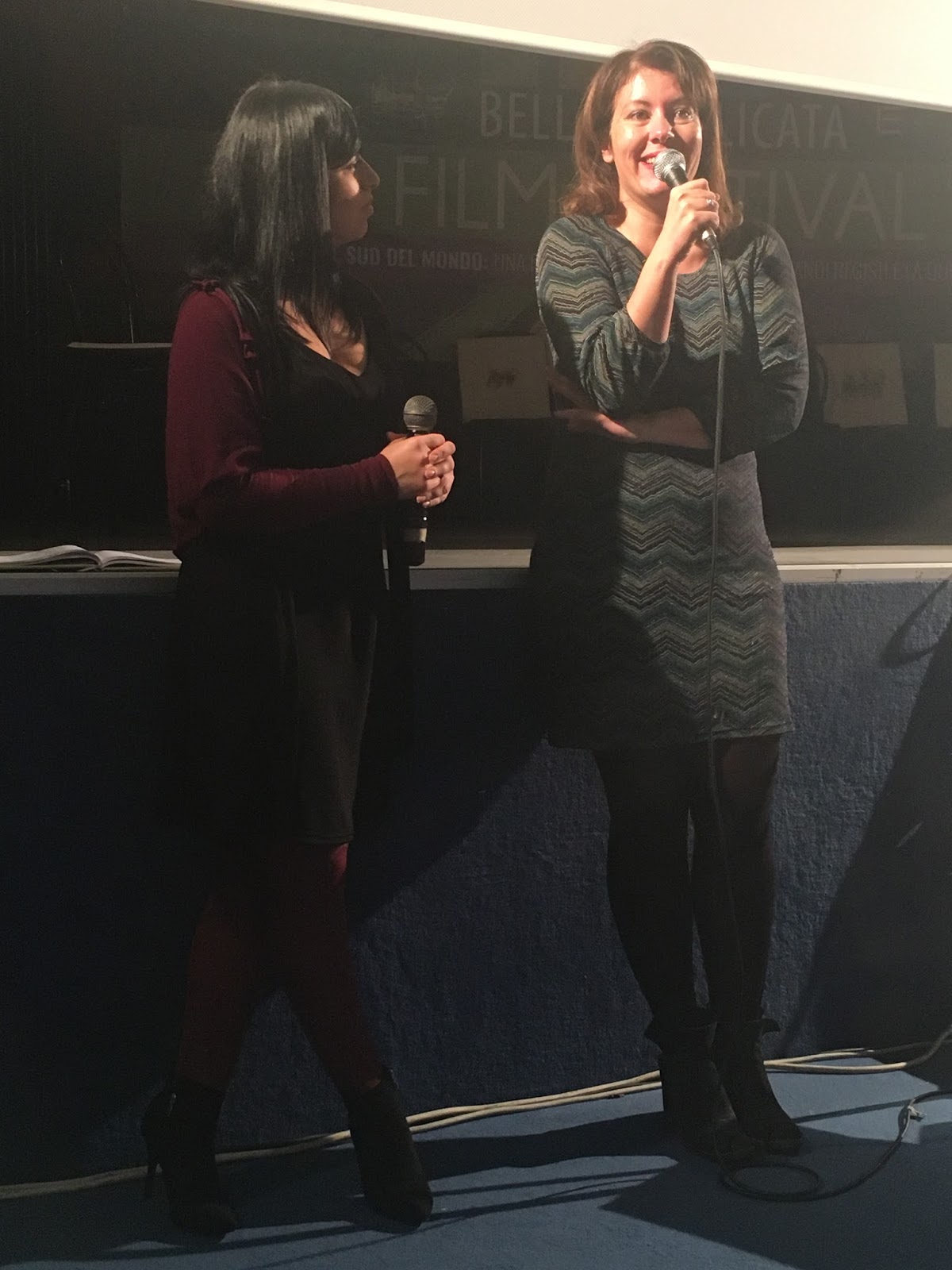
Ponzano during Q&A at the Bella Basilicata Film Festival
Is distribution in place for the film?

Festival distribution, yes. The world premiere for "la Slitta" will be in Belgium at the 32 FIFA Festival International du film d’Amour de Mons on 24 February, and I’m happy about that.


Born in Brussels, Emanuela Ponzano is an actress and director in both cinema and theatre. She divides her time working mainly between Rome, Paris and Brussels. In 1995, having completed her degree in Political Science at the ULB in Brussels, Ponzano decided to dedicate herself completely to theatre and film. She worked for a cultural program for radio  and studied dramatic arts at the Conservatoire Royal in Liège with Jacques Delcuvellerie (Groupov- Rwanda 94-Ecole des Maitres) and Max Parfondry, where she attained the diploma de Premier Prix in June 2000.

Ponzano has directed a number of films. In 2008, she directed the experimental short film "Bagnasciuga" and the short film "Riflessi". They have since been shown at many national and international festivals and won three National prizes in 2010. "La Slitta" is her
second short narrative fiction film. She is currently developing the script for her first feature.
We will keep you posted on future distribution for La Slitta. In the meantime, check out the trailer and follow the film on Facebook.


Comments

Popular posts from this blog

Ornella Muti: Five decades of Acting and Still Going Strong

Ornella Muti was born Francesca Romana Rivelli in Rome in 1955 to a Neapolitan father and an Estonian mother. She began her career as a model during her teenage years and made her film debut in 1970 with “La Moglie più bella” (The Most Beautiful Wife).  Her follow-up role was in the 1971 film, “Sole nella pelle” (Sun on the Skin), in which she played the daughter of wealthy parents who runs off with a hippie they don’t approve of. The film offers a telling journey through Italian society in the seventies, with its political climate, breathtaking seaside, and the styles and cars of that time.  Much of the film is set amid the sunny Italian seaside and captures the innocence and beauty of first love.   Muti made her American film debut in 1980 with "Flash Gordon." She played the role of Princess Aura. She’s appeared in two other American films, including “Oscar,” directed by John Landis and starring Don Ameche, Chazz Palminteri, and Sylvester Stallone. In 1992, she w...

The Anthology Film Archives Presents: The Italian Connection: Poliziotteschi and Other Italo-Crime Films of the 1960s and '70's

June 19 – June 29 Influenced both by 1960s political cinema and Italian crime novels, as well as by French noir and American cop movies like "Dirty Harry" and "The French Connection," many Italian filmmakers in the late-60s and early-70s gradually moved away from the spaghetti western genre, trading lone cowboys for ‘bad’ cops and the rough frontier of the American west for the mean streets of modern Italy. Just as they had with their westerns, they reinvented the borrowed genre with their inimitable eye for style and filled their stories with the kidnappings, heists, vigilante justice, and brutal violence that suffused this turbulent moment in post-boom 1970s Italy. The undercurrent of fatalism and cynicism in these uncompromising movies is eerily reminiscent of the state of discontent in Italy today. ‘The Italian Connection’ showcases the diversity and innovation found in the genre, from the gangster noir of Fernando Di Leo’s "Caliber 9" ...

Model/Actress Anna Falchi

Anna Falchi was born Anna Kristiina Palomaki, on April 22, 1972, in Tampere, Finland. Her mother, Kaarina Palomaki Sisko, is Finnish, while her father, Benito "Tito" Falchi, is from Romagna, Italy. Growing up in Italy, Anna was a tomboy, and had a fervent imagination. She is known mostly for her prolific career in modelling. However, she tried her hand at acting and landed a role in one of my favorite Italian comedies, Nessun messaggio in segreteria . I consider it my one of my favorites because it brought together so many amazing, talented filmmakers during a time when they were all just starting out. Those filmmakers, Pierfrancesco Favino, Valerio Mastandrea, Luca Miniero and Paolo Genovese are now huge names in contemporary Italian cinema, so it's great to look back and see their work in a low-profile film completely different from the bigger-budget stardom they now know.   Watch the trailer . Anna Falchi started her career as a...

Ettore Scola explores enduring friendships and lost ideals in 'C’eravamo tanto amati'

A scene from "C'eravamo tanti amati" Mixing both tragedy and humor, Ettore Scola ’s 1974 film “C’eravamo tanto amati” (“We All Loved Each Other So Much”) follows 30 years in the lives of three men and the woman they each adore. By examining how his generation changed after the war, Scola makes a film that reflects its era. Scola explores the moral, political and emotional evolution of Italy’s postwar generation and, in doing so, creates a film that is a chronicle of its time and a love letter to cinema. The story begins in the aftermath of World War II. Three friends — Antonio ( Nino Manfredi ), Gianni (Vittorio Gassman) and Nicola (Stefano Satta Flores) — emerge from the Italian Resistance with a shared dream of justice, equality and social renewal. They are united by their hope that the sacrifices of war will lead to a better world. But the decades that follow prove to be challenging as Italy undergoes massive social changes, from the postwar economic boom to the politi...

Federico Fellini: A Look into the Life and Career of an Icon

A Fellini family portrait  “The term became a common word to describe something on the surface you can say is bizarre or strange, but actually is really like a painter working on a film,” said Martin Scorsese when asked to define “Felliniesque,” an adjective inspired by one of the greatest filmmakers of all time. The oldest of three children, Federico Fellini was born in the seaside town of Rimini in 1920. His father was a traveling salesman, so his mother was left to do the bulk of raising the children. One can argue that Fellini was born for his destiny. “You could tell that even as a child, he was different and unique. He was very intelligent, well above average. He was always the one to organize things, direct the others, make up games. He could control the other kids with just a look, said Fellini’s sister, Maddalena, in an interview with journalist Gideon Bachmann.  Not only was Fellini directing the children, but he was also putting on shows and charging ...